Mediation vs. Self-Resolution: Conflict Management Strategies

Effectively managing conflicts requires understanding the core differences between mediation and self-resolution, as each strategy offers distinct benefits and drawbacks depending on the specific context and parties involved.
Navigating disagreements is an inevitable part of life, whether in personal relationships, professional settings, or community interactions. When faced with disputes, understanding the options available for resolution is crucial. This article delves into the critical differences between mediation vs. self-resolution for conflict management, exploring when each approach is most effective and how to maximize its potential for a positive outcome.
Understanding self-resolution in conflict management
Self-resolution, at its core, is the process where individuals involved in a conflict directly communicate and work together to find a mutually acceptable solution without the intervention of a third party. This approach relies heavily on the parties’ ability to engage in open dialogue, empathetic listening, and a willingness to compromise. It often begins informally, perhaps with a simple conversation, and can escalate or de-escalate based on the participants’ communication skills and emotional intelligence.
The success of self-resolution hinges on several factors, including the nature of the relationship between the parties, the complexity of the issue, and the emotional climate surrounding the conflict. When successful, it can strengthen relationships, build trust, and empower individuals by demonstrating their capacity to overcome challenges together. However, it also demands a high degree of emotional regulation and a commitment from all sides to genuinely seek a resolution rather than simply ‘winning’ an argument.
Key characteristics of self-resolution
Self-resolution is characterized by its directness and informality, making it a flexible option for many types of disputes. There’s no set agenda or formal procedure, allowing the conversation to flow organically as parties express their views and explore solutions.
- Direct communication: Parties speak directly to each other, fostering a sense of ownership over the process and outcome.
- Flexibility: The process is adaptable to the specific needs and dynamics of the individuals involved.
- Empowerment: Individuals gain confidence in their ability to handle conflicts independently.
- Relationship building: Successful self-resolution can deepen understanding and strengthen bonds.
When self-resolution is effective
Self-resolution is particularly effective in situations where the parties have an ongoing relationship, a vested interest in maintaining that relationship, and a relatively equal power dynamic. It works best when emotions are manageable, and there’s a foundation of respect and trust. For instance, minor disagreements between colleagues, misunderstandings within a family, or small disputes between neighbors can often be resolved through direct communication. The key is that all parties are willing to engage constructively and are capable of setting aside immediate grievances to focus on long-term solutions.
However, it’s important to recognize its limitations. If emotions are running high, communication has broken down, or there’s a significant power imbalance, self-resolution might not be the most appropriate or effective path. In such cases, the conflict can escalate, leading to further damage to relationships and potentially more entrenched positions.
Exploring mediation as a conflict management tool
Mediation introduces a neutral third party, the mediator, to facilitate communication and negotiation between individuals in conflict. Unlike self-resolution, where parties directly control every aspect of the discussion, mediation provides a structured environment guided by a professional. The mediator does not make decisions or impose solutions but rather helps the parties explore their interests, identify common ground, and generate their own mutually acceptable agreements. This process is voluntary and confidential, offering a safe space for difficult conversations.
The role of the mediator is crucial. They are trained to manage dynamics, reframe issues, ensure all voices are heard, and help de-escalate tension. Their neutrality is paramount, ensuring that no party feels unfairly treated or pressured. Mediation can be applied to a wide range of disputes, from family law matters like divorce and child custody to workplace conflicts, commercial disagreements, and community disputes. Its versatility makes it a powerful alternative to more adversarial processes like litigation.
The structured process of mediation
Mediation typically follows a structured process, even though its flexibility allows for adaptation to specific circumstances. This structure helps maintain order and focus, especially when emotions are high or the issues are complex.
- Introduction and ground rules: The mediator explains the process, their role, and establishes guidelines for respectful interaction.
- Information gathering: Each party presents their perspective on the conflict, allowing the mediator to understand the core issues and underlying interests.
- Issue identification and agenda setting: The mediator helps narrow down the key points of contention and sets an agenda for discussion.
- Option generation and negotiation: Parties brainstorm potential solutions, with the mediator guiding them toward mutually beneficial options.
- Agreement writing: If a resolution is reached, the mediator helps draft a clear, comprehensive agreement.
Benefits of professional mediation
Professional mediation offers distinct advantages, particularly when self-resolution has failed or is deemed inappropriate. The presence of a neutral third party can transform a contentious discussion into a productive dialogue, providing a pathway to resolution that might otherwise be unattainable. Mediators are skilled in various communication techniques, enabling them to bridge communication gaps and facilitate understanding between parties who may be deeply entrenched in their positions.
One significant benefit is the preservation of relationships. By focusing on interests rather than positions, mediation helps parties understand each other’s needs, often leading to solutions that acknowledge and respect both sides. This is particularly valuable in ongoing relationships, such as those between co-parents, business partners, or neighbors. Furthermore, mediation is generally less expensive and time-consuming than litigation, offering a more efficient route to resolving disputes. The confidential nature of mediation also encourages open discussion, as parties can speak freely without fear that their statements will be used against them in a public forum.
Key differences: mediation vs. self-resolution
The fundamental distinction between mediation vs. self-resolution for conflict management lies in the involvement of a third party. Self-resolution is a direct, two-party process, while mediation introduces a neutral facilitator. This core difference cascades into various aspects of how conflicts are approached and resolved, impacting the level of formality, structure, and required skills from the participants.

In self-resolution, the responsibility for guiding the conversation, managing emotions, and finding solutions rests entirely with the disputing parties. They must possess strong communication skills, empathy, and a willingness to compromise. This can be empowering but also challenging, especially if one or both parties lack these skills or if the emotional intensity of the conflict is high. There is no external figure to de-escalate tension or ensure fairness, making it a test of the parties’ own abilities to navigate difficult conversations constructively.
Mediation, conversely, offloads some of this burden onto the mediator. The mediator acts as a guide, providing a framework and tools to help parties communicate effectively. This external support can be invaluable when communication has broken down, or when power imbalances make direct negotiation difficult. The mediator ensures that discussions remain productive, that all perspectives are heard, and that agreements are fair and sustainable. This structured support can transform seemingly intractable conflicts into manageable discussions, leading to resolutions that satisfy all involved.
Structural and procedural differences
The procedural differences between these two approaches are significant and influence their suitability for various conflict types.
- Third-party involvement: Self-resolution has no third party; mediation always involves a neutral mediator.
- Formality and structure: Self-resolution is informal and unstructured; mediation is structured with defined stages.
- Decision-making authority: In both, parties retain decision-making power, but the mediator guides the negotiation in mediation.
- Confidentiality: Both are typically confidential, but mediation often has formal confidentiality agreements.
- Cost: Self-resolution is free; mediation involves fees for the mediator’s services.
Impact on relationships and outcomes
Both approaches aim to resolve conflict, but their impact on relationships and the nature of the outcomes can vary. Self-resolution, when successful, can significantly strengthen relationships by building trust and demonstrating mutual problem-solving capabilities. The shared effort in overcoming a challenge can lead to a deeper understanding and appreciation of each other’s perspectives. The outcomes are entirely generated by the parties, which can lead to a strong sense of ownership and commitment to the agreement.
Mediation also aims to preserve and even improve relationships. The mediator’s role in facilitating understanding and respectful dialogue often helps parties see beyond their immediate grievances. While the solutions are still generated by the parties, the mediator’s guidance can lead to more creative and comprehensive agreements that address underlying interests more effectively. The structured environment can prevent further damage to relationships that might occur in unstructured, highly emotional self-resolution attempts, offering a safer path toward reconciliation and resolution.
When to choose self-resolution
Deciding between mediation vs. self-resolution for conflict management often comes down to assessing the specific circumstances of the dispute. Self-resolution is often the first and most natural approach, particularly when the conflict is minor, and the parties involved have a strong foundation of trust and respect. It leverages existing relationships and can be incredibly efficient if both sides are willing and able to communicate effectively.
Consider self-resolution when the emotional intensity of the conflict is low to moderate. If emotions are not overwhelming the ability to think clearly and communicate rationally, direct dialogue can be highly productive. It also works best when there is a relatively balanced power dynamic between the parties. If one party holds significantly more power or influence, the other party might feel intimidated or unheard, making genuine self-resolution difficult. In such cases, the less powerful party might feel coerced rather than truly agreeing to a solution.
Ideal scenarios for self-resolution
Several scenarios lend themselves well to self-resolution, highlighting its practicality and effectiveness in everyday situations.
- Minor disagreements: Small misunderstandings or differences of opinion that don’t involve deep-seated issues.
- Strong existing relationships: Conflicts between friends, family members, or long-term colleagues who value their bond.
- Equal power dynamics: Situations where neither party dominates the conversation or decision-making.
- High trust and communication skills: Parties are capable of open, honest, and respectful dialogue.
- Desire for quick resolution: When a formal process is unnecessary, and a swift solution is preferred.
Developing effective self-resolution skills
To succeed in self-resolution, individuals can cultivate several key skills. Active listening is paramount, allowing each party to fully understand the other’s perspective without interruption or judgment. Empathy helps in stepping into the other person’s shoes, fostering a deeper understanding of their feelings and motivations. Clear and assertive communication ensures that one’s own needs and boundaries are expressed effectively without being aggressive.
Furthermore, a willingness to compromise and focus on shared interests rather than rigid positions is essential. Conflict is rarely about one person being entirely right and the other entirely wrong; often, there are legitimate concerns on both sides. Approaching the discussion with a problem-solving mindset, rather than a competitive one, significantly increases the chances of a positive outcome. Practice and patience are vital, as effective conflict resolution is a skill that improves over time.
When mediation is the better choice
While self-resolution offers many advantages, there are circumstances where the complexities of a conflict or the dynamics between parties necessitate the intervention of a neutral third party. The choice between mediation vs. self-resolution for conflict management often leans towards mediation when direct communication has failed, or when the stakes are too high to risk further damage to relationships or legal standing. Mediation provides a structured, safe environment that can help bridge communication gaps and facilitate resolution even in highly contentious situations.
Consider mediation when emotions are running high, making rational discussion difficult. A mediator can help de-escalate tension, ensure that each party has an opportunity to speak and be heard, and prevent the conversation from spiraling into unproductive arguments. It is also an excellent choice when there’s a significant power imbalance between the parties, as the mediator can help level the playing field, ensuring that the less powerful party’s voice is adequately represented and considered. This ensures that any agreement reached is truly voluntary and fair, rather than coerced.
Complex conflicts and high stakes
Mediation is particularly well-suited for conflicts involving complex legal, financial, or emotional issues, where the consequences of an unresolved dispute could be severe. Examples include divorce proceedings, business partnership dissolutions, or large-scale workplace disputes.
- Legal implications: When agreements need to be legally binding or involve significant legal considerations.
- High emotional intensity: Situations where anger, fear, or resentment prevent constructive dialogue.
- Communication breakdown: When parties are unable or unwilling to communicate directly and respectfully.
- Power imbalances: To ensure fairness and equal voice when one party is significantly more powerful.
- Need for creative solutions: When standard solutions don’t fit, and a neutral facilitator can help explore innovative options.
The role of the mediator in difficult situations
In difficult situations, the mediator’s expertise becomes indispensable. They are not merely passive observers but active facilitators who use a range of techniques to move the parties toward resolution. This includes reframing inflammatory language into neutral terms, identifying underlying interests that may not be immediately apparent, and guiding the brainstorming of creative solutions. The mediator acts as a crucial buffer, absorbing tension and ensuring that discussions remain focused on problem-solving rather than blame.
Furthermore, a skilled mediator can help parties manage unrealistic expectations and confront difficult truths in a supportive manner. Their neutrality and professional distance allow them to address sensitive issues without taking sides, fostering an environment where parties feel safe enough to explore compromises. This guidance is particularly vital in disputes where trust has been eroded, and parties are hesitant to engage directly, making mediation a powerful tool for rebuilding communication and achieving lasting agreements.
Hybrid approaches and combined strategies
Sometimes, the ideal solution for mediation vs. self-resolution for conflict management isn’t an either/or choice, but rather a combination of both. Hybrid approaches recognize that conflicts often evolve, and what starts as a simple disagreement suitable for self-resolution might escalate, eventually requiring mediation. Conversely, a mediation process might lay the groundwork for parties to continue negotiating and refining their agreement through self-resolution once the core issues are addressed and communication channels reopened.
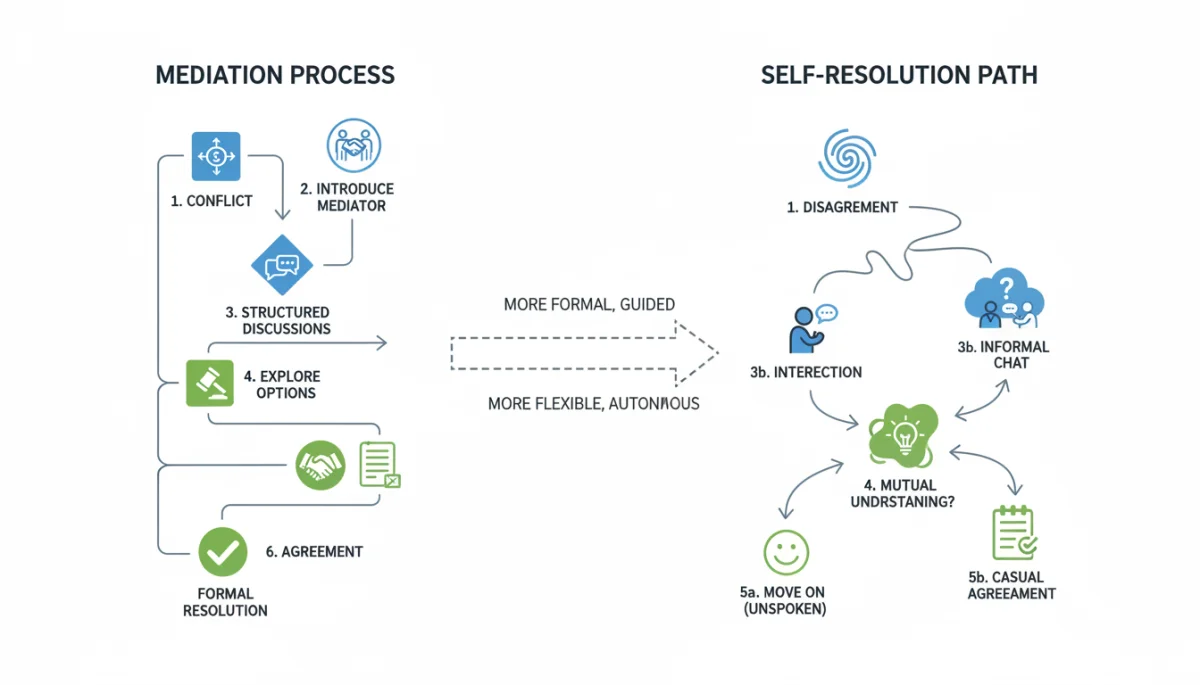
One common hybrid approach involves an initial attempt at self-resolution. If parties find themselves stuck or unable to make progress, they might then engage a mediator to help overcome specific hurdles. The mediator can facilitate a few sessions to address the most contentious points, and once a breakthrough is achieved, the parties can return to self-resolution to finalize the details. This allows for the benefits of both approaches: the cost-effectiveness and empowerment of self-resolution, combined with the structured support and expertise of mediation when needed.
Another hybrid model involves shuttle diplomacy, where a mediator communicates separately with each party, especially when direct communication is too volatile. Once a common understanding or potential solution emerges, the mediator might bring the parties together for a joint session. This approach is particularly useful in high-conflict situations where trust is severely damaged, and direct interaction could be counterproductive. The mediator acts as a trusted go-between, carefully conveying messages and exploring options until a direct meeting becomes feasible.
Benefits of blending strategies
Combining self-resolution and mediation can offer a flexible and highly effective pathway to conflict resolution, adapting to the dynamic nature of disputes.
- Flexibility: Allows for adaptation as the conflict evolves and parties’ needs change.
- Cost-effectiveness: Utilizes mediation only when absolutely necessary, saving resources.
- Increased ownership: Parties retain control over parts of the process, fostering commitment to outcomes.
- Enhanced communication: Mediation can teach parties skills they later apply in self-resolution.
- Sustainable solutions: Addresses both immediate issues and long-term relationship health.
Choosing the right blend
The key to successful hybrid approaches lies in judiciously choosing when and how to integrate mediation into a self-resolution effort. It requires an honest assessment of the conflict’s intensity, the parties’ communication capabilities, and the potential for escalation. If an initial self-resolution attempt stalls due to emotional barriers or communication breakdowns, bringing in a mediator for even a limited number of sessions can be a game-changer. The mediator can help clear the air, establish ground rules for respectful dialogue, and provide tools for productive negotiation.
Ultimately, the goal is to find the most efficient and effective path to resolution that preserves relationships and provides lasting solutions. By understanding the strengths and weaknesses of both self-resolution and mediation, and by being open to combining them, individuals can navigate conflicts with greater confidence and achieve more satisfactory outcomes.
The role of communication in both approaches
Regardless of whether one opts for mediation vs. self-resolution for conflict management, effective communication remains the bedrock upon which any successful resolution is built. Without clear, respectful, and open communication, even the most well-intentioned efforts can falter. In self-resolution, communication is the primary tool, directly shaping the interaction and outcome. In mediation, while a third party facilitates, the ability of the disputants to articulate their needs and listen to others is still paramount for the mediator to guide them effectively.
Poor communication often lies at the heart of conflicts. Misunderstandings, unexpressed needs, assumptions, and defensive reactions can all contribute to escalating tensions. Therefore, developing and employing strong communication skills is not just beneficial but essential for anyone seeking to resolve disputes. This involves not only speaking clearly but also, crucially, listening actively—truly hearing and understanding the other person’s perspective, even if you disagree with it. It also means managing one’s own emotional responses to ensure that communication remains constructive rather than destructive.
Essential communication skills for conflict resolution
Cultivating specific communication skills can significantly improve the chances of successful conflict resolution, whether independently or with a mediator’s help.
- Active listening: Paying full attention, asking clarifying questions, and summarizing to ensure understanding.
- Empathy: Trying to understand and share the feelings of another, even if you don’t agree with their actions.
- “I” statements: Expressing feelings and needs from your own perspective rather than making accusations.
- Non-verbal communication awareness: Being mindful of body language and tone, both your own and others’.
- Reframing: Rephrasing negative or accusatory statements into neutral, problem-focused language.
Communication in self-resolution vs. mediation
In self-resolution, parties are solely responsible for managing the communication flow. This requires a high degree of self-awareness and discipline to avoid common communication pitfalls like interrupting, making assumptions, or becoming defensive. The success of self-resolution is a direct reflection of the parties’ communication prowess and their commitment to a respectful dialogue. They must be able to articulate their grievances and desires clearly, while also being open to hearing and validating the other person’s viewpoint.
In mediation, the mediator acts as a communication coach and traffic controller. They can intervene when communication breaks down, reframe hostile statements, and teach parties more effective ways to interact. While the mediator facilitates, the parties are still actively communicating, but within a more controlled and supportive environment. This guidance can be invaluable for parties who struggle with direct communication, helping them to develop better habits that can even improve their future self-resolution attempts. Ultimately, both paths underscore that effective conflict resolution is inextricably linked to the quality of communication exchanged.
Long-term benefits and sustainability of resolutions
The ultimate goal of any conflict management strategy, be it mediation vs. self-resolution for conflict management, is not just to reach a temporary truce but to achieve a sustainable resolution that addresses the root causes of the dispute and prevents recurrence. The durability of an agreement often depends on how well it meets the underlying interests of all parties and whether they feel a sense of ownership over the outcome. Both self-resolution and mediation, when executed effectively, can lead to highly sustainable solutions, but they do so through different mechanisms.
In self-resolution, the direct involvement and shared effort in crafting a solution often lead to a strong sense of ownership and commitment. When parties genuinely collaborate to overcome a challenge, they are more likely to adhere to the agreement because it reflects their collective input and understanding. This process can also equip individuals with enhanced conflict-resolution skills, empowering them to address future disagreements more effectively without external help. The lessons learned through self-resolution can foster greater resilience in relationships and a proactive approach to potential conflicts.
Ensuring lasting agreements
For an agreement to be truly lasting, it must be practical, fair, and address the core concerns that led to the conflict. Both self-resolution and mediation aim for this, but the support structure differs.
- Mutual agreement: Both approaches prioritize solutions generated by the parties themselves, increasing commitment.
- Addressing underlying interests: Effective resolution goes beyond surface-level demands to meet deeper needs.
- Clarity and specificity: Agreements should be clear, unambiguous, and outline specific actions.
- Flexibility and review: Sometimes, agreements include provisions for future review or adjustment.
- Relationship repair: Success in either method can lead to improved relationships, reducing future conflict potential.
The role of trust and commitment
Trust and commitment are pivotal in ensuring the sustainability of any resolution. In self-resolution, if trust is already present, the process can reinforce it. If trust has been eroded, successful self-resolution can be a powerful step towards rebuilding it. The act of engaging directly, listening, and compromising demonstrates mutual respect and a willingness to work together, which are fundamental to lasting peace. The commitment to the agreement stems from the personal investment each party has made in its creation.
Mediation can be particularly effective in fostering trust and commitment when they are initially lacking. The mediator’s neutrality and guidance help create a safe space where parties can begin to trust the process, and eventually, each other. By facilitating a fair and balanced discussion, the mediator helps ensure that the final agreement is one that all parties can genuinely commit to, not just out of obligation, but because they believe it is the best possible outcome. This shared commitment, whether forged directly or with the help of a mediator, is what transforms a temporary solution into a sustainable resolution, promoting long-term harmony and understanding.
| Conflict Management Strategy | Key Characteristics |
|---|---|
| Self-Resolution | Direct communication between parties, informal, no third-party involvement. Relies on mutual trust and communication skills. |
| Mediation | Involves a neutral third-party mediator, structured process, facilitated communication. Ideal for complex or high-emotion conflicts. |
| Communication Role | Crucial in both; direct in self-resolution, facilitated in mediation. Essential for understanding and agreement. |
| Hybrid Approaches | Combining elements of both, starting with self-resolution and moving to mediation if needed, or using shuttle diplomacy. |
Frequently asked questions about conflict resolution
The primary difference lies in third-party involvement. Self-resolution involves direct communication between the disputing parties without external help. Mediation introduces a neutral third party, a mediator, who facilitates communication and negotiation to help parties reach their own agreement.
Self-resolution is most effective for minor disagreements, when parties have a strong existing relationship, possess good communication skills, and there’s a balanced power dynamic. It works best when emotions are manageable and all parties are willing to openly discuss and compromise.
Mediation offers a structured, confidential environment with a neutral facilitator to guide discussions. Benefits include de-escalating high emotions, bridging communication gaps, ensuring fairness in power imbalances, and helping parties generate creative, sustainable solutions for complex disputes.
Yes, hybrid approaches are common. Parties might start with self-resolution and turn to mediation if they reach an impasse, or a mediator might facilitate key discussions, allowing parties to finalize details independently. This flexibility optimizes resources and leverages strengths of both methods.
Communication is fundamental to both self-resolution and mediation. Effective communication, including active listening, empathy, and clear expression of needs, is crucial for understanding perspectives, managing emotions, and collaboratively working towards a mutually acceptable and sustainable agreement.
Conclusion
The journey through conflict resolution, whether through mediation vs. self-resolution for conflict management, reveals that there is no one-size-fits-all approach. Each method offers unique strengths and is best suited for different circumstances. Self-resolution empowers individuals to directly address disputes, fostering stronger relationships and personal growth when conditions are favorable. Mediation provides invaluable structure, neutrality, and expertise, particularly for complex or emotionally charged conflicts where direct communication has failed. Ultimately, the most effective strategy often involves a discerning assessment of the conflict’s nature, the parties’ dynamics, and a willingness to adapt. By understanding these approaches and cultivating strong communication skills, individuals and organizations can navigate disagreements more constructively, leading to more sustainable resolutions and healthier relationships in the long run.
