Understanding Personal Space in the US: A Comprehensive Guide
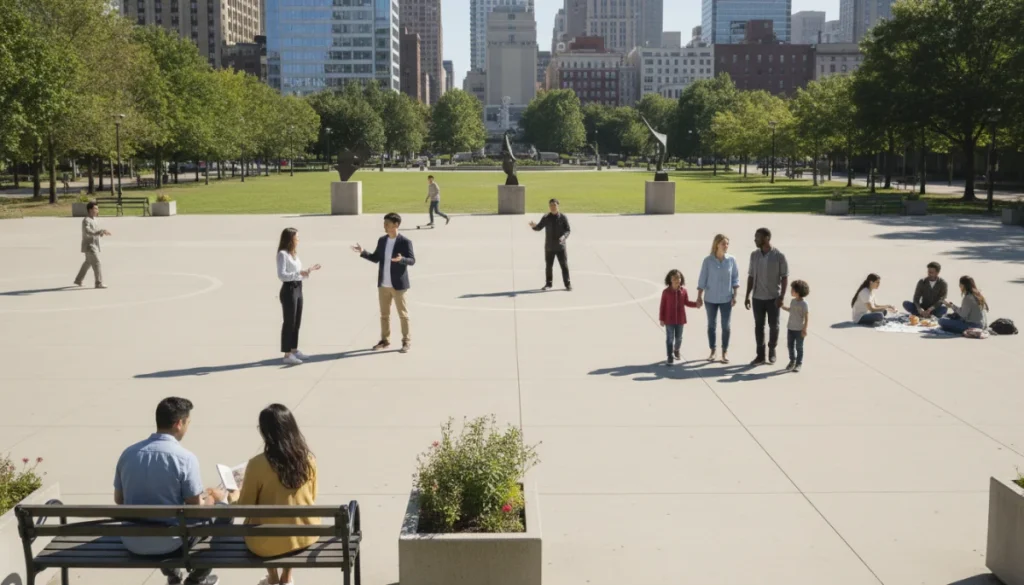
Understanding Personal Space in the US is crucial for effective communication and comfortable social interactions, as cultural norms dictate varying distances for different relationships and situations.
Understanding Personal Space in the US is a fundamental aspect of successful social interaction, often subtle but profoundly impactful. Navigating these unwritten rules can be a delicate dance, influencing everything from casual conversations to professional encounters. For newcomers and even long-time residents, grasping these nuances is key to fostering comfortable and respectful relationships within American society.
The concept of proxemics: defining personal space
Proxemics, the study of human use of space and the effects that population density has on behavior, communication, and social interaction, was first coined by anthropologist Edward T. Hall. In the United States, these spatial preferences are deeply ingrained, shaping how individuals perceive and react to proximity in various social contexts. It is not merely about physical distance but also about psychological comfort and cultural expectations.
Hall identified four main categories of distance that Americans typically observe, each corresponding to different types of relationships and situations. These categories provide a useful framework for understanding personal space in the US and predicting appropriate behavior.
Intimate distance: close relationships only
Intimate distance typically ranges from direct contact to about 18 inches. This zone is reserved for very close relationships, such as romantic partners, family members, or close friends. Entry into this zone by anyone else is generally considered an invasion of privacy and can cause significant discomfort. It’s a space where physical touch and soft whispers are common.
- Close embrace: Direct physical contact, whispering.
- Romantic partners: Hugs, holding hands, close conversations.
- Family members: Comforting touches, personal grooming.
The violation of intimate space by non-intimate individuals can trigger a fight-or-flight response, leading to feelings of anxiety or aggression. It’s a powerful indicator of trust and vulnerability, making its boundaries fiercely protected.
Personal distance: friends and acquaintances
Personal distance extends from 1.5 to 4 feet and is characteristic of interactions with friends, acquaintances, and often, colleagues. This zone allows for comfortable conversation without feeling too close or too distant. It’s the “arm’s length” rule that many Americans intuitively follow.
Within this range, eye contact is more direct, and voices are typically at a normal conversational volume. It allows for a sense of connection while maintaining individual boundaries. Understanding this distance is crucial for casual social settings and informal gatherings.
For example, when meeting a new acquaintance at a party, maintaining a distance of about two to three feet is generally considered appropriate. This allows for easy conversation and the ability to read non-verbal cues without feeling intrusive. Crossing this boundary too quickly can make the other person feel uncomfortable or even threatened, hindering the development of a positive relationship.
Social distance: formal and impersonal interactions
Social distance, ranging from 4 to 12 feet, is employed for more formal and impersonal interactions. This includes business meetings, classroom settings, or interactions with service providers. It signals a level of formality and professionalism, allowing for clear communication without the expectation of personal connection.
This distance is often observed in public spaces where individuals are not expected to have a close relationship. Think about waiting in line at the bank or interacting with a cashier; maintaining social distance is the norm. It provides a buffer that allows for a sense of privacy and respect for individual boundaries, even in crowded environments. Violating this zone can be perceived as overly aggressive or inappropriately familiar.
Professional settings and public interactions
- Business meetings: Sitting across a table, maintaining a professional distance.
- Customer service: Standing a few feet from the counter.
- Public transport: Avoiding direct eye contact and maintaining maximum possible distance.
The upper end of social distance, around 10 to 12 feet, is often used in more formal group settings, such as a presentation or a formal reception. This distance allows a speaker to address a group effectively while maintaining a sense of authority and detachment. It’s a critical aspect of understanding personal space in the US within various professional and public spheres.
Public distance: speeches and large gatherings
Public distance extends from 12 feet and beyond, typically used for public speaking or addressing large groups. At this distance, the interaction is largely one-way, with the speaker projecting their voice and gestures to a broad audience. Personal interaction is minimal, and the focus is on conveying information to many people simultaneously.
This zone minimizes direct personal engagement and emphasizes the speaker’s role as a figure of authority or a performer. It’s the space where a lecturer addresses students, a politician speaks to constituents, or a performer entertains an audience. The distance helps to create a sense of scale and formality appropriate for such large-scale communication.
In these situations, individuals in the audience are not expected to engage in personal conversation with the speaker. Instead, they are passive recipients of information. The large distance also helps to reduce the feeling of intrusion, allowing individuals to feel comfortable even in very crowded public spaces. This is a crucial distinction when considering the dynamics of understanding personal space in the US in various public scenarios.
Cultural variations and individual differences
While Hall’s classifications provide a general framework for understanding personal space in the US, it is important to acknowledge that cultural variations and individual differences play a significant role. The United States is a melting pot of cultures, and individuals from different backgrounds may have varying expectations regarding proximity.

For instance, people from certain Latin American, Middle Eastern, or Southern European cultures often prefer closer distances in conversation than those from Northern European or Asian cultures. These differences can lead to misunderstandings if not recognized. An American might perceive someone standing too close as aggressive or overly familiar, while the other person might interpret the American’s tendency to step back as coldness or disinterest.
Factors influencing personal space preferences
- Cultural background: Learned norms from one’s upbringing.
- Gender: Men and women may have slightly different comfort zones.
- Age: Younger individuals might be more flexible than older ones.
- Personality: Introverts might prefer more space than extroverts.
- Relationship type: The closer the relationship, the smaller the acceptable distance.
Moreover, individual personality traits and past experiences also influence personal space preferences. Someone who has experienced trauma or has a naturally introverted personality might require more personal space than an extroverted individual. Recognizing these variations is essential for empathetic and effective communication, preventing unintentional offense or discomfort.
Navigating personal space in everyday situations
Successfully navigating personal space in the US requires observation and adaptability. In unfamiliar situations, it is always a good strategy to observe how others are interacting and adjust your distance accordingly. When in doubt, it is generally safer to err on the side of giving more space rather than less, as it is easier to move closer if invited than to retreat once a boundary has been crossed.
Pay attention to non-verbal cues such as leaning in or pulling back, maintaining or breaking eye contact, and shifts in body orientation. These signals can provide valuable insights into someone’s comfort level. For instance, if someone consistently steps back when you approach, they are likely signaling a need for more space. Conversely, if they lean in and maintain strong eye contact, they might be inviting closer interaction.
Practical tips for respectful interaction
- Observe and adapt: Watch others and mirror their distance.
- Respect boundaries: If someone steps back, give them space.
- Be mindful of context: Different settings require different distances.
- Avoid aggressive encroachment: Do not corner people or stand too close.
In professional environments, maintaining a respectful social distance is paramount. During a job interview, for example, sitting across a desk maintains a professional barrier. In a casual office conversation, a personal distance is usually appropriate. Understanding personal space in the US is not just about avoiding awkwardness, but about building trust and demonstrating respect in all interactions, from formal to informal.
The impact of personal space on communication
The distance we keep from others significantly impacts the effectiveness and interpretation of communication. When personal space is respected, communication tends to flow more smoothly, fostering a sense of ease and receptiveness. Conversely, violations of personal space can create barriers, leading to discomfort, defensiveness, and misinterpretation of messages.
For example, if someone stands too close during a serious conversation, the recipient might feel intimidated or overwhelmed, making it difficult for them to process the information or respond thoughtfully. Their focus shifts from the message itself to the discomfort of the proximity. This can lead to shorter interactions, a desire to escape the conversation, and a negative perception of the communicator.
Conversely, maintaining an appropriate distance allows both parties to feel secure and open. It facilitates better eye contact, allows for clearer perception of facial expressions and body language, and encourages a more relaxed exchange of ideas. This is especially important in situations requiring empathy or negotiation, where trust and comfort are vital. Mastering the art of understanding personal space in the US is therefore an indispensable skill for effective communication.
Non-verbal cues related to space
- Eye contact: Can be intense or avoidant based on distance.
- Body orientation: Direct facing or angled stances.
- Posture: Open or closed body language.
The subtle cues of personal space can convey as much as, if not more than, spoken words. A person who maintains a comfortable distance signals respect and consideration, fostering a positive environment for dialogue. Those who consistently invade personal space may be perceived as insensitive or aggressive, regardless of their intentions, highlighting the profound impact of spatial dynamics on interpersonal communication.
| Key Aspect | Brief Description |
|---|---|
| Intimate Distance | Reserved for closest relationships (0-1.5 feet), involves high trust. |
| Personal Distance | Used for friends and acquaintances (1.5-4 feet), comfortable conversation. |
| Social Distance | For formal and impersonal interactions (4-12 feet), professional settings. |
| Cultural Variations | Personal space norms differ across cultures and individuals, requiring adaptability. |
Frequently asked questions about personal space in the US
In the US, the typical personal space bubble for casual interactions is generally between 1.5 to 4 feet, known as personal distance. For more formal or public settings, it extends to 4 to 12 feet. This range allows for comfortable conversation while respecting individual boundaries.
Cultural differences significantly impact personal space. Individuals from cultures that prefer closer proximity might inadvertently invade the space of someone from a culture that values more distance, leading to potential misunderstandings. Awareness and adaptability are crucial for effective cross-cultural communication in the US.
Yes, generally it is considered rude or intrusive to stand too close to someone in the US, especially if you do not have a close relationship with them. It can make the other person uncomfortable, anxious, or even perceive it as aggressive, hindering positive interaction.
Look for non-verbal cues such as stepping back, turning away, avoiding eye contact, or crossing arms. These are common indicators that someone feels their personal space is being invaded. Observing and respecting these subtle signals is key to polite interaction.
While general guidelines apply, personal space can subtly vary. Urban areas might see slightly smaller distances due to population density, while rural areas might maintain larger distances. However, the core principles of intimate, personal, social, and public distances largely remain consistent across the nation.
Conclusion
Mastering the art of understanding personal space in the US is more than just adhering to a set of rules; it is about cultivating empathy, respect, and effective communication in a diverse society. By recognizing the nuanced layers of proxemics, from intimate to public distances, and by acknowledging both cultural and individual variations, one can navigate social interactions with greater confidence and grace. Paying attention to non-verbal cues and adapting one’s behavior accordingly not only prevents discomfort but also builds stronger, more positive relationships. Ultimately, a deep appreciation for these unwritten spatial norms enhances one’s ability to connect meaningfully within the American social landscape.
